$65.00

Sadaqah for Umrah and Hajj

Out of stock

We are pleased to facilitate Sadaqah for minor violations committed during Umrah and Hajj by providing food to the poor and needy in Makkah. This service allows pilgrims to rectify their oversights while directly benefiting the underprivileged within the boundaries of the Haram.

With our 100% donation policy, every contribution you make is entirely dedicated to supporting and feeding those in need, ensuring your Sadaqah fulfills its intended purpose without any deductions.

Read more

Category:
Description

What is Sadaqah for Umrah and Hajj violations?

In the context of Hajj and Umrah, Sadaqah refers to a compensatory act of charity (Fidyah) required for minor violations of the pilgrimage rituals. These violations may include actions like covering the head while in Ihram, wearing stitched clothing briefly, or accidentally plucking a few hairs. Unlike major violations, which may necessitate a Dam (animal sacrifice), minor mistakes can often be rectified by offering Sadaqah, such as feeding the poor or giving monetary charity.

What type of Sadaqah do you provide?

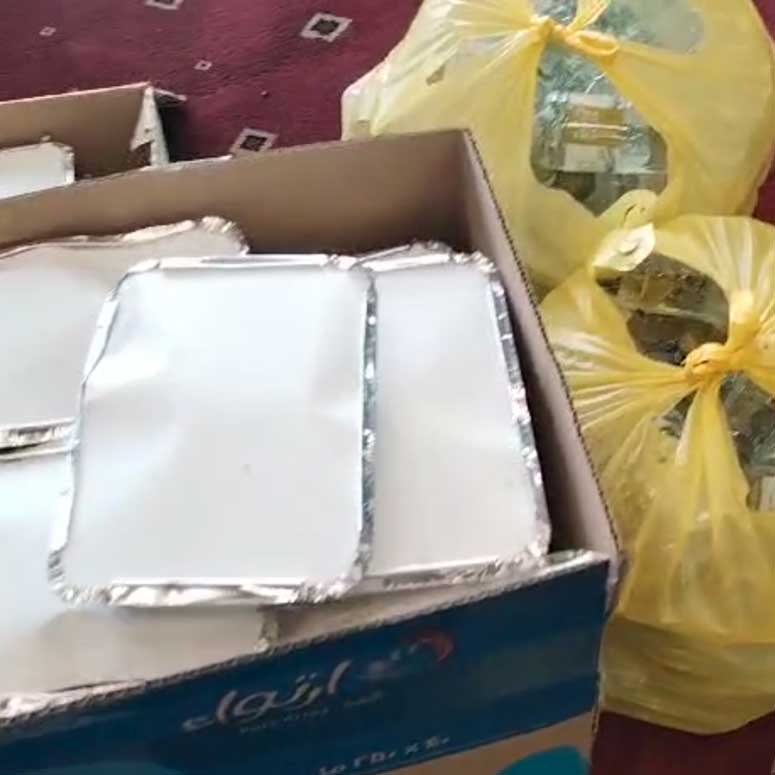
The Sadaqah you order will take the form of meals for the poor and needy in Makkah. These meals will be carefully distributed to ensure they reach those in most need. The recipients will include:

Recipients of Sadaqah may include:

  1. Poor and Needy Local Residents – Individuals and families struggling to meet basic needs due to financial hardships.
  2. Refugees – Those displaced from their countries, seeking shelter and support in Makkah.
  3. Orphans – Children who have lost one or both parents and are in need of support.
  4. Elderly People – Senior citizens who may not have family support and are living in poverty.
  5. Widows – Women who have lost their spouses and are struggling to care for themselves and their families.
  6. Foreign Workers – Migrant workers who may be working in Makkah with low wages and limited support systems.

Will I receive proof of the Sadaqah?

You will receive an email notification confirming that your Sadaqah has been distributed. Additionally, upon request, we can provide an image or video of the distribution process.

What is the difference between Sadaqah and Dam?

Sadaqah and Dam are both types of compensatory acts (Fidyah) for violations during Hajj and Umrah, but they differ in terms of severity and type of expiation. Sadaqah is required for minor violations, such as wearing stitched clothing briefly or clipping nails. The expiation typically involves giving charity. On the other hand, Dam is a more significant expiation for major violations. It generally involves slaughtering an animal, such as a sheep or goat, and distributing the meat to the poor. In essence, Sadaqah is for minor mistakes and usually involves charity, while Dam is for major violations and requires a sacrificial animal.

Summary of the Difference Between Sadaqah and Dam


Sadaqah

Dam

Nature

Minor compensation

Major compensation

Form

Feeding the poor or giving money

Animal sacrifice

Severity of Violation

Small violation

Significant or major violation

Location

Not restricted to Haram

Must be performed in the Haram

Does Sadaqah have to be given in the Haram?

No, Sadaqah does not have to be given in the Haram. Unlike Dam, which requires the sacrifice to be performed within the boundaries of the Haram, Sadaqah can be given anywhere. For compensating minor violations during Hajj or Umrah, the charity can be donated to the poor and needy wherever they may be. The charity must be given with the intention of seeking Allah’s forgiveness for the violation committed.

Why might I need to pay Sadaqah?

Following are some violations during Umrah or Hajj that might necessitate the giving of Sadaqah:

  • Applying perfume on less than one body part.
  • Wearing stitched clothing for less than a day.
  • Covering the head for less than a day.
  • Shaving less than a quarter of the hair on the head or beard.
  • Shaving hair anywhere on the body except for the head, beard, throat, neck, armpits, and below the navel.
  • Clipping the nails of less than five fingers or toes.
  • Killing an insect.

What are the prerequisites for the validity of Sadaqah?

For Sadaqah in the context of Fidyah to be valid, the following conditions must be met:

  1. Amount: The prescribed amount for Sadaqah is 1.666 kg of wheat, wheat flour, or 3.332 kg of barley, barley flour, or dates/raisins. If other food items are given, they should be equivalent in value. Cash can also be given, and it is preferable to provide it in cash.
  2. Recipients: Sadaqah should not be given to those who possess nisab (minimum zakatable wealth), an unbeliever, or a dhimmi (non-Muslim living in an Islamic state). However, it can be given to travellers or those who remained behind from Hajj. It is also permissible to give it to siblings, uncles, and aunts etc.
  3. Feeding the Poor: If feeding the poor, the person must be provided with enough for two full meals (morning and evening or two evenings). A person must be fed until they are full, and if the food is less than the required amount, they should be given more.
  4. Intention: The intention for the Fidyah (compensatory act) must be made at the time of giving.
Reviews (0)

Reviews

There are no reviews yet.

Be the first to review “Sadaqah for Umrah and Hajj”

Your email address will not be published. Required fields are marked *